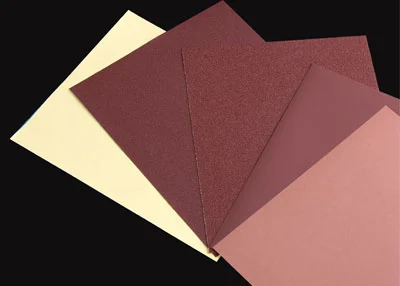
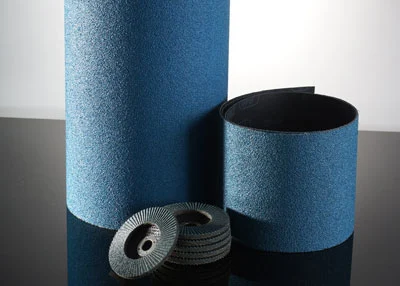
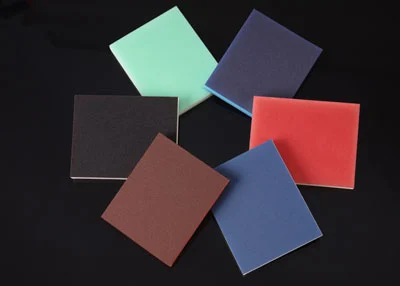
In 2026, finishing teams are being asked to do more with less — faster cycle times, broader material coverage, and tighter surface quality standards, often within the same production shift. A finishing line that handles painted automotive panels in the morning and carbon fiber composite components in the afternoon cannot afford an abrasive that performs well in one condition and fails in the other. Yet that is exactly the situation that paper-backed abrasives create when wet sanding enters the workflow.
The failure mode of paper in wet sanding is well understood and consistently underestimated. Water penetrates the paper fibers, softening the backing and reducing its dimensional stability. The disc or sheet that was flat and consistent when dry begins to curl at the edges, deform under pressure, and lose the uniform contact geometry that produces consistent scratch depth. The operator continues sanding, but the scratch pattern is no longer controlled — some areas are cut deeper where the softened backing has concentrated pressure, and some areas are cut shallower where the backing has lifted away from the surface. The result is a surface that requires more polishing passes to correct, or in precision applications, a geometry deviation that requires rework.
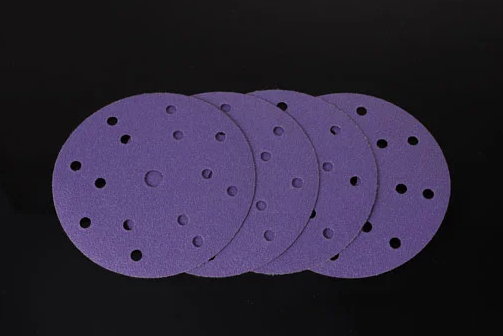
Purple sandpaper built on a film backing — specifically the AF39M purple abrasive film — solves this by replacing the paper substrate with a water-resistant polymer film that maintains its dimensional stability in both wet and dry conditions. The film does not absorb water, does not soften, and does not deform under the pressure and temperature of sustained sanding. For finishing operations that must cover composites, precision molds, and coated surfaces across wet and dry processes, the AF39M film backing is the specification that makes consistent performance achievable across all of those applications. For buyers sourcing wholesale velcro backup abrasives across multiple stations and material types, it also provides a path to inventory standardization that paper-backed products cannot support.
The performance difference between paper-backed and film-backed abrasives in wet sanding is not a matter of grain quality or grit specification. It is a structural difference in how the backing responds to moisture and mechanical stress.
Paper backing is manufactured from cellulose fibers that are inherently hygroscopic — they absorb water from the environment and from the wet sanding lubricant applied during use. As the paper absorbs water, the fiber structure softens and the backing loses the stiffness that maintains its flat contact geometry. The disc or sheet begins to deform under the pressure of sanding, and the contact between the abrasive surface and the workpiece becomes uneven.
The consequences of that deformation are visible in the scratch pattern. A softened paper backing concentrates pressure at the points where the backing has deformed toward the workpiece, producing deeper scratches in those areas. In the areas where the backing has lifted away from the surface, the abrasive contact is lighter and the scratches are shallower. The result is a scratch profile with high variance — some areas are cut to the correct depth, some are over-cut, and some are under-cut. When the polishing step begins, the technician is working against an inconsistent baseline that requires variable effort across the correction area.
Edge tearing is the other failure mode that wet paper backing is prone to. The softened paper at the disc edge has reduced tensile strength, and the cyclic stress of sanding — particularly on contoured surfaces and near edges — causes the paper to tear at the perimeter. Each tear-out ends the disc's useful life prematurely and may leave a torn edge that scratches the workpiece before the operator notices the failure.
The film substrate of AF39M purple sandpaper is a polymer film that does not absorb water. When the disc or sheet is used in wet sanding with water or lubricant, the backing remains dimensionally stable — it does not soften, does not curl, and does not deform under the pressure of sanding. The flat contact geometry that produces consistent scratch depth is maintained from the beginning of the sanding pass to the end, regardless of how much lubricant is applied.
That dimensional stability is the property that makes film-backed purple sandpaper suitable for precision applications where paper fails. On a precision mold surface where the scratch depth must be consistent to within a few micrometers across the full sanded area, a backing that deforms under wet conditions introduces geometry errors that are difficult to correct without additional finishing steps. On a carbon fiber composite panel where the surface must be prepared to a consistent scratch profile before coating, a backing that produces variable scratch depth creates coating adhesion variation that shows up as gloss inconsistency after painting.
The film backing also provides higher edge tear resistance than paper in wet conditions, because the polymer film does not lose tensile strength when wet. The disc survives the edge and contour work that tears wet paper, allowing the sanding pass to be completed without interruption.
Specifying the right AF39M purple sandpaper configuration for a finishing operation requires matching the film thickness, grit range, and attachment format to the process requirements and the tool configuration.
The thickness and flatness of the film backing determine how consistently the abrasive surface contacts the workpiece across the full disc or sheet face. A thicker, flatter film provides a more rigid reference surface that maintains consistent contact pressure across the sanding area, which is the property that produces consistent scratch depth on precision surfaces.
For precision mold finishing and composite surface preparation where dimensional accuracy is a primary requirement, film flatness is the specification that determines whether the sanding step achieves the required surface condition or introduces geometry variation that requires correction. A film that is not flat — due to manufacturing variation or storage deformation — produces the same uneven contact pressure that a softened paper backing produces, defeating the purpose of the film substrate.
The grit sequence determines the balance between material removal rate and surface finish quality at each stage of the finishing process. For defect removal and leveling — removing machining marks, EDM recast layer, or surface contamination — a coarser grit with higher cut rate is appropriate. For refinement and pre-polish preparation — reducing the scratch depth to the level required for polishing — a medium to fine grit is appropriate.
Defining the sanding objective for each grit step before specifying the sequence allows the step-down plan to be optimized for the specific application. The goal is to use the fewest steps that achieve the required surface condition, because each additional step adds time and abrasive cost. For most composite and mold finishing applications, a two-to-three step sequence — leveling, refinement, and pre-polish preparation — covers the full range from correcting surface defects to preparing for polishing.
The attachment format — hook-and-loop, PSA, or sheet — determines how the abrasive is installed on the tool and how quickly it can be changed between steps. For operations sourcing wholesale velcro backup abrasives across multiple stations and material types, standardizing on hook-and-loop attachment provides the fastest changeover and the easiest hole alignment for dust extraction.
Hook-and-loop attachment also allows the disc to be repositioned for hole alignment without damaging the disc or the pad, which is particularly important in wet sanding applications where correct hole alignment affects both extraction efficiency and lubricant distribution. Standardizing the attachment format across all sanding steps and stations reduces the number of pad configurations that need to be maintained in inventory and simplifies the training required for operators switching between steps.
The applications where AF39M purple film creates the most significant performance advantage over paper-backed abrasives are those where wet sanding is required, where dimensional accuracy is a primary requirement, or where the material being sanded is sensitive to the scratch depth variation that paper deformation produces.
Carbon fiber reinforced polymer (CFRP) and fiberglass reinforced polymer (FRP) components require surface preparation that is both consistent and controlled. The composite structure is sensitive to over-sanding — cutting through the surface resin layer into the fiber reinforcement creates a surface defect that is difficult to correct and may compromise the structural integrity of the component. Consistent scratch depth across the full sanded area is the requirement that prevents over-sanding in localized areas.
Wet sanding on composites is often preferred because it reduces the generation of fine carbon fiber and glass fiber dust, which is a health hazard and a contamination risk for adjacent surfaces. Film backing's water resistance makes it the appropriate choice for wet composite sanding — the backing maintains its dimensional stability in the wet environment, producing consistent scratch depth that protects the composite surface from localized over-sanding.
The purple color of AF39M also provides a visual indicator of abrasive wear that is useful in composite finishing — as the abrasive grain wears, the color change at the disc surface provides a visual cue that the disc is approaching the end of its effective cutting life.
Precision mold finishing requires scratch depth consistency that is measured in micrometers. A mold surface that has been sanded to an inconsistent scratch profile will produce a polished surface with visible texture variation — areas where the scratch was deeper will require more polishing passes to reach the required Ra, and areas where the scratch was shallower will be over-polished before the deeper areas are corrected.
Film backing's dimensional stability in both wet and dry conditions makes it the appropriate choice for precision mold finishing because it maintains the flat contact geometry that produces consistent scratch depth across the full mold surface. The AF39M film's flatness specification supports the dimensional accuracy that precision mold finishing requires, and its water resistance allows wet sanding to be used where dust control or surface quality requirements make it preferable to dry sanding.
Post-coating refinement — correcting dust nibs, orange peel, and surface defects in clearcoat and topcoat — is an application where scratch depth consistency directly determines how much polishing work is required to restore full gloss. A consistent scratch profile from the sanding step can be removed efficiently in a predictable number of polishing passes. An inconsistent scratch profile requires variable polishing effort and increases the risk of cut-through on edges and high spots.
Wet sanding for post-coating refinement is common in automotive finishing and high-end furniture production because it reduces heat at the abrasive interface and produces a finer, more consistent scratch pattern than dry sanding at the same grit. Film backing's stability in wet conditions makes it the appropriate choice for this application, and the AF39M's dimensional stability supports the scratch depth consistency that efficient polishing requires.
Specifying AF39M purple sandpaper for a production finishing operation requires a structured approach that matches the film specification to the process requirements and the tool configuration.
Start by identifying the substrate and the sanding method. Composite surfaces requiring wet sanding need a film backing with high water resistance and edge tear resistance. Precision mold surfaces requiring dimensional accuracy need a film backing with high flatness and consistent thickness. Painted surfaces requiring post-coating refinement need a film backing that maintains consistent contact in both wet and dry conditions.
Define the grit sequence based on the starting surface condition and the required finish. For composite surface preparation, the starting grit should be matched to the surface condition after machining or layup — coarser for rough surfaces with significant texture, finer for surfaces that are already relatively smooth. For mold finishing, the starting grit should be matched to the defect type being removed — EDM recast layer requires a coarser starting grit than light machining marks.
Select the attachment format based on the tool configuration and the changeover requirements. For operations sourcing wholesale velcro backup abrasives across multiple stations, hook-and-loop attachment standardizes the pad configuration and simplifies inventory management. Confirm that the disc diameter and hole pattern match the backing pad before placing a bulk order.
For wet sanding, keep the lubricant film consistent across the full sanding area. Dry patches on the surface during wet sanding create localized areas of higher friction and deeper scratching that break the consistency of the scratch profile. A consistent lubricant application — either by misting the surface before sanding or by applying lubricant to the disc face — is part of achieving the uniform scratch depth that film backing is designed to support.
For dry sanding, ensure that extraction is active and that the disc holes are aligned with the pad's extraction channels. Film backing's dimensional stability is most fully realized when the cutting zone is kept clean by effective extraction — dust accumulation at the interface reduces the consistency of abrasive contact even when the backing is dimensionally stable.
Replace worn pads before they cause disc slippage or uneven contact. A pad that has lost significant hook engagement or whose surface has deformed from wear produces an uneven contact pressure distribution that affects scratch depth consistency regardless of the backing specification.
The cost argument for AF39M purple sandpaper in wet and dry finishing applications is built on failure mode reduction — fewer disc failures from paper softening and tearing, fewer rework cycles from inconsistent scratch depth, and fewer polishing passes from a more consistent starting surface.
Paper softening and tearing in wet sanding are the most direct sources of waste that film backing eliminates. Each disc that tears prematurely in wet sanding is a disc that was discarded before its grain was worn out — the abrasive cost of the disc was not fully recovered. Each tear-out also stops the sanding pass and requires a disc change, adding changeover time to the total correction cost.
Inconsistent scratch depth from paper deformation is the source of rework that is most expensive to address. A surface that has been sanded to an inconsistent scratch profile requires additional polishing passes to correct, and in precision applications, it may require re-sanding before polishing can begin. Each additional correction step adds labor time and increases the risk of over-correction on edges and high spots.
For operations sourcing wholesale velcro backup abrasives across multiple stations and material types, the ability to standardize on a single film specification for both wet and dry applications reduces the number of SKUs in the abrasive inventory. Fewer SKUs means simpler purchasing, lower risk of stockouts for specific sizes, and less operator confusion about which product to use for which application.
Track parts per disc or sheet in both wet and dry conditions before and after switching to AF39M film. Track time-to-finish at the same acceptance standard — the number of sanding passes and polishing passes required to reach the required surface condition. Track rework minutes from scratch inconsistency and geometry deviation. Track consumables reduction from standardizing SKUs across wet and dry steps.
These four metrics, measured over one to two weeks of production, give a clear picture of the cost saving that the film specification delivers in the specific application. The rework reduction and polishing time saving are typically the largest contributors to the total cost difference, because they affect labor cost rather than just abrasive consumable cost.
When a finishing operation must cover both wet and dry sanding across multiple material types — composites, precision molds, and coated surfaces — the backing specification is the variable that determines whether performance is consistent across all of those conditions or whether it degrades in the wet applications. Paper backing fails in wet sanding in a predictable and costly way: it softens, deforms, and produces the scratch depth inconsistency that drives rework and extended polishing cycles.
AF39M purple sandpaper on a film backing eliminates that failure mode. The water-resistant polymer film maintains its dimensional stability in wet conditions, producing consistent scratch depth on composites and precision mold surfaces where paper deformation would introduce geometry errors. The same film backing performs equally well in dry sanding, making it a single specification that covers both process types without compromise. For operations sourcing wholesale velcro backup abrasives across multiple stations, that versatility simplifies inventory and reduces the risk of using the wrong product in a wet application.
To receive a recommended grit plan, format specification, and wholesale velcro backup abrasives quotation, visit the AF39M purple abrasive film product page and submit the following details:
Operating conditions: material type (CFRP, FRP, tool steel, primer, or topcoat), wet versus dry sanding, tool type (DA sander, orbital sander, or hand block), extraction or lubrication method
Quantity: monthly usage volume, number of lines or stations, trial quantity versus wholesale volume
Size and specs: disc diameter or sheet size, hole pattern if applicable, hook-and-loop requirement, grit range and sequence
Target metrics: scratch consistency target, polishing time reduction goal, dimensional accuracy requirement, defect rate goal
Current problems: paper softening or warping in wet sanding, edge tearing, inconsistent scratch depth, long polishing time, geometry deviation on precision parts
Q1: What is AF39M purple sandpaper in this context?
AF39M purple sandpaper refers to a purple-colored abrasive product built on a film backing rather than a paper backing. The purple color is characteristic of the film substrate and the abrasive formulation used in this product line. The key differentiator from conventional sandpaper is the film substrate's water resistance and dimensional stability — the backing does not absorb water, does not soften in wet sanding conditions, and maintains its flat contact geometry throughout the sanding pass. It is used in applications where paper backing fails due to moisture exposure, including wet sanding of composites, precision mold finishing, and post-coating refinement on painted surfaces.
Q2: What is the difference between AF39M purple film and traditional paper sandpaper?
Traditional paper sandpaper uses a cellulose fiber backing that absorbs water and softens in wet sanding conditions, causing the backing to deform, curl, and lose the flat contact geometry that produces consistent scratch depth. Paper backing also loses tensile strength when wet, making it prone to edge tearing under the cyclic stress of sanding. AF39M purple film uses a polymer film backing that does not absorb water, maintains its dimensional stability in wet conditions, and provides higher edge tear resistance than wet paper. The practical difference is more consistent scratch depth in wet sanding, fewer disc failures from edge tearing, and better dimensional accuracy on precision surfaces.
Q3: What is the ROI of switching from paper sandpaper to AF39M purple film?
The return on investment comes from three sources: fewer disc failures from paper softening and tearing in wet sanding, fewer rework cycles from inconsistent scratch depth, and shorter polishing time from a more consistent starting surface. The correct metric for the ROI calculation is cost per finished part — total abrasive spend plus changeover labor plus rework and polishing labor, divided by good parts produced. For operations that wet sand frequently or that finish precision surfaces where scratch depth consistency is critical, the rework reduction and polishing time saving typically recover the unit price premium within the first few weeks of production.
Q4: Do we need to modify tools to use AF39M purple abrasive film?
No tool modifications are required. The transition involves selecting the correct format — disc or sheet — and confirming that the disc diameter, hole pattern, and attachment type match the existing tool and pad configuration. For hook-and-loop attachment, confirming that the pad's hook engagement is in good condition before switching ensures that the disc is held securely and that hole alignment is maintained during sanding. Process settings — pressure and speed — may be standardized as part of the transition to ensure that the film backing's dimensional stability advantage is fully realized in the specific application.
Q5: What parameters should we provide for accurate selection and quoting?
For the most useful recommendation, provide the substrate type and the specific application — composite surface preparation, precision mold finishing, or post-coating refinement — along with whether the process is wet or dry sanding, the tool model and operating settings, the desired grit range and number of steps, the disc or sheet size, the hole pattern and extraction method or wet lubrication method, the monthly usage volume, and the primary problems currently being experienced — paper softening or warping, edge tearing, inconsistent scratch depth, long polishing time, or dimensional accuracy issues on precision parts.