In 2026, finishing teams are held to a standard that leaves very little room for rework. Paint-ready surfaces must pass inspection on the first attempt, coating adhesion must be consistent across every transition and edge, and the labor cost of re-priming, re-sanding, and repainting a rejected part has climbed to the point where a single sand-through incident on a high-value component can consume the profit margin of the entire job.
Yet edge and contour sanding remains the step where quality most frequently collapses. The reason is mechanical and predictable. When an operator uses paper sandpaper on a curved surface, a groove, or a sharp edge transition, the paper does not conform to the geometry — it bridges across it. The contact between the abrasive and the workpiece is concentrated at the highest points of the geometry: the edge arris, the ridge of a molding, the outer radius of a curve. At those contact points, the full force of the operator's hand is applied to a very small area. The local pressure is far higher than the average pressure across the sanding pass, and the material removal rate at those points is correspondingly higher. The primer or base coat at the edge is cut through before the surrounding surface has been adequately prepared. The part goes to paint with a sand-through defect that requires stripping, re-priming, curing, re-sanding, and repainting — a rework cycle that is many times more expensive than the abrasive that caused it.
An abrasive sponge — also called a sponge abrasive — solves this by introducing a compressible body between the operator's hand and the abrasive surface. The sponge compresses under hand pressure, distributing the force across a wider contact area rather than concentrating it at the highest points of the geometry. The result is a more uniform pressure distribution across curves, grooves, and edge transitions that reduces the sand-through risk that paper creates and improves the consistency of the scratch pattern across the full contour.
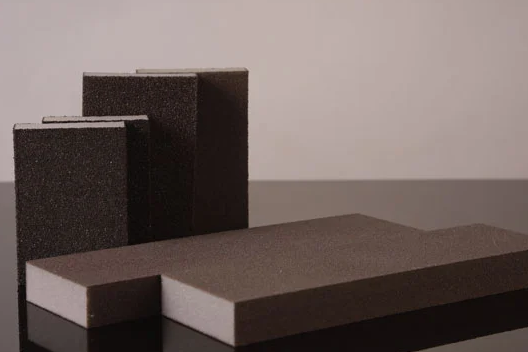
The working principle of an abrasive sponge is a direct response to the pressure concentration failure mode of paper sandpaper on contoured surfaces. Understanding the physics of that failure mode makes it clear why the sponge's compressibility solves the problem.
Paper sandpaper has a relatively rigid backing that does not conform to surface geometry under hand pressure. When paper is held against a curved surface, it makes contact at the peaks of the geometry — the edges, ridges, and outer radii — and bridges across the recesses and inner curves. The contact area is small, and the full force of the operator's hand is concentrated at those contact points.
The relationship between contact area and pressure is direct: halving the contact area doubles the pressure at the contact zone for the same applied force. On a sharp edge or a small radius, the contact area may be a fraction of the total abrasive face area, which means the local pressure at the edge is many times higher than the operator intends. The abrasive removes material at a rate proportional to the local pressure, so the edge is cut faster than the surrounding surface. On a primed or coated surface, that accelerated removal cuts through the coating layer before the operator realizes the edge has been over-sanded.
The problem is compounded by the natural tendency of operators to apply more pressure when they feel the abrasive is not cutting effectively on the curved areas between the contact points. That additional pressure increases the local pressure at the edge contact zones further, accelerating the sand-through risk.
An abrasive sponge changes the pressure distribution by introducing a compressible body that deforms to match the surface geometry rather than bridging across it. When the sponge is pressed against a curved surface, the sponge body compresses at the contact points and expands into the recesses, increasing the contact area across the full geometry of the surface. The force applied by the operator's hand is distributed across that larger contact area, reducing the local pressure at any single point.
This pressure buffering effect is the mechanism that reduces sand-through risk on edges and contours. The local pressure at the edge contact zone is lower than it would be with paper, because the sponge has distributed the force across a wider area. The material removal rate at the edge is more consistent with the removal rate on the surrounding surface, which means the coating thickness at the edge is reduced at a rate that is proportional to the rest of the surface rather than accelerated by pressure concentration.
The scratch pattern produced by the sponge abrasive is also more consistent across the contour than the scratch pattern produced by paper, because the contact area is more uniform. A consistent scratch pattern is the prerequisite for consistent coating adhesion after priming and painting — areas with deeper scratches absorb more primer and areas with shallower scratches absorb less, producing coating thickness variation that shows up as gloss inconsistency after topcoat.
The physical properties of the abrasive sponge — thickness, density, grit, and coating — determine how effectively it buffers pressure and conforms to surface geometry in a specific application.
The 25mm thickness of the sponge body is the specification that determines the balance between two competing requirements in contour sanding: stability for controlled material removal and conformability for following curved geometry.
A sponge that is too thin provides insufficient compression depth to buffer pressure effectively on deep curves and grooves. The thin sponge body bottoms out against the operator's hand before it has fully conformed to the surface geometry, and the pressure distribution reverts toward the point-load pattern of paper. A sponge that is too thick is difficult to control — the excess compliance makes it hard to apply consistent pressure across the sanding pass, and the sponge may fold or buckle on tight radii rather than conforming smoothly.
The 25mm thickness provides enough compression depth to conform to the curves and transitions that are common in wood moldings, metal edge profiles, and complex contour geometries, while maintaining enough body stiffness to support controlled, consistent pressure application. It functions like a sanding block on semi-flat surfaces — providing a stable reference for the operator's hand — while conforming like a flexible abrasive on curved sections. That combination of stability and conformability is what makes the 25mm sponge the appropriate choice for the full range of contour sanding applications.
The density of the sponge body determines how much force is required to compress it to a given depth, which affects how the pressure is distributed across the contact area. A higher-density sponge requires more force to compress and provides better control on semi-flat surfaces and edges where the geometry is not highly curved. The higher resistance to compression means the sponge maintains a more defined contact face on surfaces that are close to flat, which improves the consistency of the scratch pattern on those surfaces.
A softer, lower-density sponge compresses more readily under light pressure and conforms more easily to tight curves, deep grooves, and complex profiles where the geometry changes direction frequently. The lower resistance to compression allows the sponge to follow the surface geometry more closely, maintaining abrasive contact across the full profile rather than bridging across recesses. For applications where the primary requirement is conformability — inside grooves, complex molding profiles, and tight radii — a softer sponge density is the appropriate choice.
The grit selection determines the balance between material removal rate and surface finish quality at each stage of the contour sanding process. Coarser grits are appropriate for shaping and leveling on raw wood and metal preparation — removing machining marks, surface contamination, and rough texture. Medium grits are appropriate for primer scuffing and blending — preparing a primed surface for topcoat by creating a consistent scratch profile that the topcoat can bond to. Fine grits are appropriate for pre-finish refinement — reducing the scratch depth to the level required for polishing or final coating.
The step-down strategy should use the fewest grit steps that achieve the required surface condition. Each additional step adds time and abrasive cost. For most contour sanding applications, a two-step sequence — leveling and refinement — covers the full range from correcting surface defects to preparing for coating. Defining clear stopping criteria for each step — a visual inspection under raking light, a tactile check for residual scratches, or a measurement of surface roughness — prevents over-sanding that wastes abrasive and increases sand-through risk.
The abrasive sponge creates the most significant performance difference in applications where the surface geometry concentrates pressure at edges and transitions and where sand-through is the primary quality risk.
Decorative wood moldings — door frames, cabinet profiles, furniture edges, and architectural trim — combine flat sections, curved transitions, and sharp edge details in a single continuous profile. Paper sandpaper on these profiles makes contact at the flat sections and the outer radii of the curves, bridges across the inner curves and grooves, and concentrates pressure at the sharp edge transitions. The result is a surface where the flat sections and outer radii are over-sanded relative to the inner curves and grooves, and where the sharp edges are at risk of sand-through.
An abrasive sponge conforms to the full profile of the molding, maintaining abrasive contact across the flat sections, the curves, and the transitions simultaneously. The pressure distribution is more uniform across the profile, which means the material removal rate is more consistent and the sharp edge details are preserved rather than rounded or cut through. The decorative geometry that the machining operation produced is maintained through the finishing operation rather than being degraded by it.
Metal components with edge profiles, contoured surfaces, and transition zones present the same pressure concentration problem as wood moldings, with the additional risk that metal edges are harder and more abrasive than wood, which accelerates the wear of the abrasive at the contact points. Paper sandpaper on a metal edge concentrates pressure at the edge arris, which removes material rapidly from the edge and can create a gouge or a radius that is outside the tolerance for the feature.
An abrasive sponge distributes the pressure across the edge profile, reducing the local removal rate at the edge arris and producing a more controlled edge break. For metal components where the edge geometry is a functional requirement — sealing surfaces, mating faces, and precision fit components — the controlled pressure distribution of the sponge abrasive is the tool that makes hand finishing of edge profiles reliable rather than operator-dependent.
Scuffing a primed surface before topcoat application is the step where sand-through risk is highest, because the primer layer is thin and the coating adhesion requirement is strict. An area of the primer that has been cut through to the substrate will not bond the topcoat correctly, producing an adhesion failure that shows up as peeling, lifting, or gloss variation after painting.
On curved and contoured surfaces, the pressure concentration of paper sandpaper makes primer cut-through a recurring risk. An abrasive sponge reduces that risk by distributing the scuffing pressure across the full contour profile, producing a consistent scratch pattern that improves topcoat adhesion without cutting through the primer at the edges and transitions. The result is a more consistent coating adhesion across the full surface, which reduces the adhesion-related defects that require rework after painting.
Specifying the right abrasive sponge configuration for a contour sanding application requires matching the sponge's physical properties to the geometry of the surface and the risk level of the application.
Start by identifying the substrate and the surface geometry. Raw wood with complex molding profiles requires a softer sponge density that conforms to tight curves and grooves. Primed metal with edge profiles requires a higher-density sponge that provides controlled pressure distribution at the edge contact zones. Coated surfaces with gentle curves require a medium-density sponge that balances conformability with controlled material removal.
Assess the sand-through risk for the application. High-value components with thin primer layers and tight coating thickness tolerances require the most conservative approach — a softer sponge density, a finer starting grit, and more frequent inspection checkpoints. Lower-value components with thicker coatings and more tolerance for surface variation can use a higher-density sponge and a coarser starting grit.
Select the sponge thickness based on the depth of the curves and grooves in the surface geometry. The 100×70×25mm format provides the balance of stability and conformability that covers the majority of contour sanding applications. For very tight grooves or very deep profiles, a softer density within the same thickness provides additional conformability without sacrificing the stability that the 25mm body provides.
Use light, consistent pressure throughout the sanding pass. The sponge's pressure buffering mechanism works most effectively when the applied force is moderate — enough to maintain consistent abrasive contact without compressing the sponge to the point where it loses its conformability advantage. Pressing harder does not improve cut rate significantly on a sponge abrasive, because the increased compression reduces the contact area advantage that the sponge provides.
Use long strokes along the contour rather than short scrubbing strokes at the edges. Long strokes distribute the sanding action evenly across the full profile and produce a more uniform scratch pattern. Short scrubbing strokes concentrate the sanding action at the edges and transitions, which is exactly the pressure concentration pattern that the sponge is designed to prevent.
Clean the surface frequently during sanding to remove debris that could be trapped between the sponge face and the workpiece. Trapped debris — abrasive particles, paint chips, or wood dust — creates localized high-pressure points that produce deep scratches inconsistent with the surrounding scratch pattern. A clean wipe between passes is a simple step that prevents the most common source of random deep scratches in sponge sanding operations.
The cost argument for abrasive sponges in contour finishing is built on first-pass yield improvement and rework avoidance. The relevant comparison is not the cost of a sponge versus a sheet of sandpaper — it is the cost of a sand-through rework cycle versus the cost of the abrasive that prevented it.
A sand-through incident on a primed or coated surface triggers a rework cycle that involves multiple steps: identifying the extent of the cut-through, re-priming the affected area, allowing the primer to cure, re-sanding the re-primed area to blend it with the surrounding surface, and repainting. Each of those steps involves labor time, material cost, and schedule disruption. For high-value components — furniture with complex profiles, automotive body panels, and architectural trim — the total cost of a single sand-through rework cycle is many times the cost of the abrasive consumables used in the finishing operation.
Reducing the frequency of sand-through incidents is the primary source of ROI from abrasive sponges. Even a small reduction in the sand-through rate — from one incident per ten parts to one incident per twenty parts, for example — produces a large reduction in rework cost when the cost per incident is high. The abrasive sponge's pressure buffering mechanism addresses the root cause of sand-through on contoured surfaces directly, making the reduction in incident rate a predictable outcome rather than a hoped-for improvement.
Track sand-through incidents per batch before and after introducing abrasive sponges into the contour finishing workflow. Track rework minutes per part — the total time spent on re-priming, re-sanding, and repainting attributable to sand-through incidents. Track first-pass yield — the percentage of parts that pass inspection without requiring rework — as the primary quality metric. Track abrasive consumption per part, including both sponge units and the time saved from reduced rework.
These four metrics, measured over one to two weeks of production, give a clear picture of the cost saving that the abrasive sponge delivers in the specific application. The rework reduction figure, expressed as minutes per part and multiplied by the labor rate, gives procurement a cost-per-part comparison that is specific to the operation and defensible in a budget review.
Run paper sandpaper and abrasive sponge on the same contour feature with the same operator and the same grit. Measure time to acceptable finish — the number of passes required to reach the required surface condition. Measure sand-through rate — the number of incidents per ten parts for each abrasive type. Measure rework time for any sand-through incidents that occur during the trial. The trial data gives a direct comparison of the two abrasive types on the specific geometry and material that drives the purchasing decision.
Sand-through on edges and contours is not an operator skill problem. It is a physics problem. Paper sandpaper concentrates pressure at the highest points of the surface geometry, and that concentrated pressure removes material faster at those points than the operator intends. No amount of care or experience fully compensates for the fundamental mechanics of pressure concentration on a rigid backing.
An abrasive sponge solves the physics problem directly. The compressible sponge body distributes hand pressure across the full contour profile, reducing the local pressure at edges and transitions to a level that is consistent with the surrounding surface. The 25mm thickness provides the balance of stability and conformability that covers the full range of contour sanding applications — from wood molding profiles to metal edge transitions to primed surface scuffing. The result is a more consistent scratch pattern, a lower sand-through rate, and a first-pass yield improvement that produces a cost-per-part saving that is large relative to the unit price difference between a sponge and a sheet of paper.
To receive a recommended sponge density, grit configuration, and quotation, visit the 100×70×25mm abrasive sponge product page and submit the following details:
Operating conditions: substrate type (wood, metal, primer, or coated surface), dry versus wet use, hand sanding method, percentage of edge and contour work in the finishing workflow
Quantity: monthly usage volume, number of operators or stations, trial quantity versus bulk order
Size and specs: 100×70×25mm or required size, density or softness preference, grit range and step sequence
Target metrics: sand-through reduction goal, first-pass yield target, time-to-finish target, surface finish requirement expressed as appearance grade or Ra
Current problems: frequent sand-through on edges or contours, edge gouging, inconsistent contour finish quality, high rework time, scratch returns before painting
Q1: What is an abrasive sponge?
An abrasive sponge is a sanding tool that combines abrasive grain bonded to the surface of a compressible sponge body. The sponge body acts as a pressure buffer between the operator's hand and the abrasive surface, distributing hand pressure across a wider contact area than paper sandpaper can achieve. This pressure distribution reduces the concentration of force at edges, ridges, and small radii that causes sand-through on contoured surfaces. Abrasive sponges are used for hand sanding of curved surfaces, grooves, molding profiles, edge transitions, and any application where the surface geometry creates sand-through risk with paper abrasives.
Q2: What is the difference between an abrasive sponge and paper sandpaper for contour sanding?
Paper sandpaper has a relatively rigid backing that bridges across curved surfaces, concentrating contact pressure at the highest points of the geometry — edges, ridges, and outer radii. That concentrated pressure accelerates material removal at those points, creating sand-through risk on primed and coated surfaces. A sponge abrasive compresses to conform to the surface geometry, distributing pressure across the full contour profile and reducing the local pressure at edges and transitions. The practical difference is a lower sand-through rate on contoured surfaces, a more consistent scratch pattern across the full profile, and better preservation of edge details and decorative geometry.
Q3: What is the ROI of switching to abrasive sponges for contour finishing?
The return on investment comes primarily from reduced sand-through incidents and the rework cycles they trigger. A sand-through rework cycle on a primed or coated surface involves re-priming, curing, re-sanding, and repainting — a total cost that is many times the cost of the abrasive consumables used in the finishing operation. Even a small reduction in sand-through frequency produces a large reduction in rework cost when the cost per incident is high. The correct metric for the ROI calculation is first-pass yield — the percentage of parts that pass inspection without rework — and rework minutes per part, not abrasive unit cost.
Q4: Do we need to modify tools or processes to use abrasive sponges?
No equipment changes are required. Abrasive sponges are designed for manual hand sanding and fit into existing finishing workflows without modification. The process changes that improve results are procedural: selecting the correct sponge density and grit for the substrate and geometry, standardizing the pressure and stroke pattern in the work instruction, and adding inspection checkpoints at each grit step to confirm that the previous step's scratch pattern has been fully removed before proceeding. These changes can be incorporated into standard work instructions without capital investment.
Q5: What parameters should we provide for accurate sponge selection and quoting?
For the most useful recommendation, provide the substrate type and coating condition — raw wood, primed surface, metal, or coated surface — the surface geometry being finished (edge radius, groove depth, molding profile complexity), the sand-through sensitivity of the application expressed as coating thickness or rework cost per incident, the preferred sponge size (100×70×25mm or a required alternative), the grit range needed for each stage of the finishing process, the monthly usage volume, and the primary problems currently being experienced — sand-through on edges, edge gouging, inconsistent contour finish quality, high rework time, or scratch returns before painting.