Procurement managers optimizing grinding lines face a three-way decision that unit price alone cannot resolve. Aluminum oxide is the cheapest option per belt, but on heavy-duty grinding applications it dulls quickly, forces frequent changeovers, and can push operators to over-press — generating heat, burn defects, and rework that inflate the true cost-per-part far beyond what the belt price suggests. Ceramic abrasives sit at the opposite end: maximum aggression and the longest belt life under extreme pressure, but at a unit cost that only pays back when the process can fully utilize that capability. Between these two extremes, the zirconia sanding belt — built on alumina zirconia sandpaper grain technology — consistently delivers the strongest practical ROI for the majority of production grinding applications on carbon steel, stainless steel, and aluminum alloys.
Understanding why requires a look at the grain-level mechanics that separate these three abrasive types, and a structured framework for matching the right choice to the specific demands of each grinding operation.
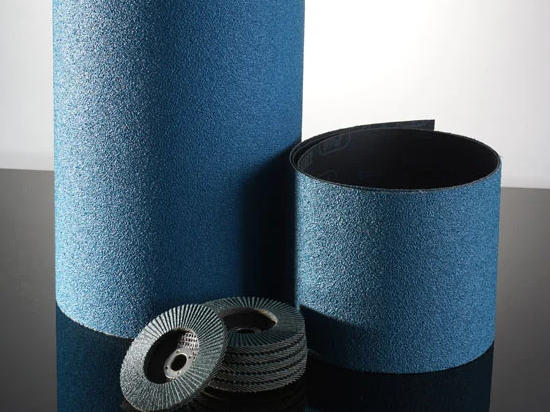
All abrasive belts remove material through grain-to-workpiece cutting contact. The performance question is what happens to the grain edges as the belt is used. Aluminum oxide grains are tough and wear-resistant — they maintain their shape under load, which sounds like an advantage until the grain edge rounds off and the grain transitions from cutting to rubbing. Once aluminum oxide grains dull, they generate heat and produce an inconsistent scratch pattern without removing material efficiently. The belt appears intact but has lost its productive cutting life.
Zirconia alumina grains behave differently. Under the pressure of heavy-duty grinding, zirconia grains micro-fracture along their crystalline structure. This fracture exposes new, sharp cutting edges — a behavior called self-sharpening — that maintains cutting efficiency across a significantly longer working life than aluminum oxide. The grain does not simply dull; it renews itself under the conditions that would cause aluminum oxide to fail.
Ceramic grains take this principle further: they are engineered for maximum self-sharpening under extreme pressure, delivering the highest removal rate and longest belt life of the three grain types. The trade-off is unit cost and the requirement that the process applies sufficient pressure to activate the ceramic grain's self-sharpening mechanism — at lower pressures, ceramic's advantage over zirconia diminishes significantly.
| Performance Variable | Aluminum Oxide | Zirconia Alumina | Ceramic |
|---|---|---|---|
| Self-sharpening behavior | Minimal — grains dull progressively | Strong — micro-fracture under pressure | Maximum — engineered for extreme conditions |
| Removal rate stability | Degrades as grains dull | Maintained longer through self-sharpening | Highest and most sustained |
| Belt life | Shortest | Moderate to long | Longest |
| Heat generation risk | Higher — dull grains rub rather than cut | Lower — active cutting reduces friction | Lowest at correct pressure |
| Unit cost | Lowest | Mid-range | Highest |
| Best ROI scenario | Light-duty, low-volume, cost-sensitive | Most heavy-duty production grinding | Extreme-pressure, high-volume, labor-cost-dominant |
View Fuji Star zirconia sanding belt specifications and dimensions
Grit range and progression must be matched to the removal target and the required finish. A grit that is too coarse for the finish requirement forces an additional finishing step; a grit that is too fine for the removal requirement extends cycle time. Define the target Ra or scratch standard and work backward to the grit ladder.
Backing and belt construction determines how the belt performs on different grinding setups. Stiffer backing suits platen grinding where flat contact is required; more flexible backing suits contact wheel grinding where the belt needs to conform to the wheel profile. Specify backing stiffness based on the grinding setup, not as a default.
Bond strength and grain adhesion is the specification that most directly affects belt life in heavy-duty grinding. Premature grain shedding — where grains detach from the backing before they have completed their useful cutting life — is the most common cause of unexpectedly short belt life. Request documentation of the bond system and grain adhesion standard before approving a supplier.
Heat management features — anti-loading coatings and treatments — are particularly important for stainless steel and aluminum grinding where heat accumulation and loading are the primary failure modes.
Belt size tolerance affects tracking stability. A belt that is out of tolerance in width or length will track inconsistently, creating edge failures and uneven wear that reduce effective belt life.
| Sourcing Factor | What to Confirm | Risk Controlled |
|---|---|---|
| Lead time and reorder cadence | Confirmed lead time with historical on-time delivery data | Line disruption from belt stockouts |
| Batch consistency documentation | Grit distribution tolerance data; QC records per lot | Inconsistent cut rate between belt batches |
| Packaging protection | Edge protection and moisture control for transit | Belt damage before use — creasing, edge damage |
| Lot traceability | Lot number on packaging; retained samples | Fast corrective action when a quality issue arises |
| Trial support | Supplier willingness to support parameter tuning trials | Suboptimal process setup that wastes belt performance |
Carbon steel is the application where zirconia alumina most consistently outperforms aluminum oxide on a cost-per-part basis. The combination of high removal rate, self-sharpening behavior under the pressure typical of carbon steel grinding, and moderate unit cost produces a belt life and throughput combination that aluminum oxide cannot match at equivalent cost. Ceramic is typically overkill for standard carbon steel grinding — the process pressure and volume required to justify ceramic's premium are not present in most carbon steel applications.
Stainless steel is heat-sensitive — overheating causes surface discoloration, metallurgical changes, and finish defects that require rework or scrap. Aluminum oxide's tendency to dull and rub rather than cut makes it a poor choice for stainless grinding because dull grains generate more heat than sharp ones. Zirconia's self-sharpening behavior maintains active cutting edges longer, reducing the heat generated per unit of material removed and lowering the risk of thermal damage.
The key additional specification for stainless steel grinding is anti-loading coating — stainless swarf is fine and sticky, and it fills the spaces between grains quickly on uncoated belts. An anti-loading treatment keeps the cutting face open and maintains cutting efficiency through the belt's working life.
Aluminum is soft and generates swarf that bonds aggressively to abrasive surfaces — loading is the dominant failure mode, not grain dulling. Zirconia can perform well on aluminum when the process is set up correctly: appropriate grit selection, controlled contact pressure to avoid smearing, and anti-loading coating to prevent swarf buildup. Without these process controls, even a premium belt will load quickly and deliver poor belt life regardless of grain type.
Choose a zirconia sanding belt when the operation requires high removal rate with controlled belt cost, when the line runs mixed jobs across different materials and needs a flexible solution, or when the grinding pressure is moderate and ceramic's extreme-pressure advantage cannot be fully utilized.
Choose ceramic when maximum aggression and the longest possible belt life under extreme pressure are required, when labor and downtime costs dominate the cost-per-part calculation and the premium belt cost is a small fraction of total process cost, and when the grinding setup applies sufficient pressure to activate ceramic's self-sharpening mechanism consistently.
Avoid aluminum oxide when the application involves heavy stock removal, when frequent belt changes are creating significant downtime, or when heat and burn defects from dull grains are generating rework.
Run a controlled trial comparing aluminum oxide, zirconia, and ceramic on the same grinding operation. Record the following for each belt type:
Time to remove a fixed amount of material (removal rate)
Number of parts completed per belt before performance drops below the acceptable threshold
Changeover minutes per shift
Defect and rework rate (burn marks, gouges, inconsistent finish)
Calculate cost-per-part for each abrasive type: belt cost divided by parts per belt, plus changeover labor cost per part, plus rework cost per part. This comparison reveals the true ROI difference between the three options on the specific operation.
For ceramic abrasive specifications and performance data: Ceramic Sandpaper — Technical Reference
The most common causes of premature zirconia belt failure are mechanical rather than abrasive:
Incorrect belt tracking or tension causes the belt to run off-center, creating edge stress that leads to splice failure and edge tearing before the abrasive surface is exhausted
Over-pressing to compensate for a belt that is past its effective cutting life generates heat that softens the bond system and accelerates grain shedding
Incorrect contact wheel or platen setup concentrates pressure at the belt edges rather than distributing it across the full belt width
Replace belts based on performance drop — a defined reduction in cut rate or a defined increase in surface temperature — rather than running belts until they fail completely. A belt that