Automotive refinishing is rarely a matter of simply sanding a surface until it looks smooth. Primer, paint, and clear coat each behave differently during surface preparation, so the same abrasive approach may not deliver the same result across every stage. A disc that removes material efficiently from a primer layer may be unnecessarily aggressive when used on a finish coat, while a fine abrasive selected for polishing preparation may struggle when substantial leveling is still required.
The key is to match the abrasive process with the coating layer, the condition of the surface, and the finish required at the next stage. For professional body shops, repair centers, and automotive manufacturers, the right automotive sanding discs can help maintain consistent scratch patterns, control material removal, and reduce the risk of rework.
This guide explains how to select and use automotive abrasives for primer, paint, and clear coat applications, with particular attention to grit selection, cutting performance, disc construction, and common sanding defects.
Primer, paint, and clear coat are not interchangeable sanding surfaces. Their purpose within a coating system is different, and that difference affects how aggressively the surface should be sanded.
Primer is generally associated with leveling and preparing the surface for subsequent coating layers. After application, it may contain minor texture, uneven areas, or surface imperfections that need to be reduced before color coating. Sanding at this stage often requires a balance between material removal and creating a uniform surface for paint adhesion.
Paint requires more controlled treatment. Depending on the repair process, sanding may involve feathering an existing coating, removing defects, blending a repaired area, or preparing an old surface for another coating layer. Excessive cutting can make the transition between repaired and original areas more difficult to manage.
Clear coat presents another challenge. Because it is the final protective and visual layer, sanding must be carefully controlled when the objective is defect correction, surface refinement, or preparation for polishing. Removing too much material can compromise the finish rather than improve it.
| Coating Layer | Typical Sanding Objective | Main Priority | Potential Problem |
|---|---|---|---|
| Primer | Leveling and surface preparation | Controlled material removal | Uneven leveling or deep scratches |
| Paint | Feathering, blending, or preparation | Uniform scratch pattern | Visible sanding transitions |
| Clear coat | Defect correction and finish refinement | Surface control | Excessive coating removal |
For this reason, choosing automotive sanding discs should begin with the question: What does the surface need to achieve at this stage? The answer is more useful than selecting a disc based only on price or general-purpose labeling.
Grit is one of the most important factors when selecting automotive abrasives. However, “finer” does not automatically mean “better.” The appropriate grit depends on how much material needs to be removed and what surface condition must be achieved afterward.
Coarser abrasives are useful when substantial leveling or material removal is required. They can help reduce uneven areas efficiently, but their more aggressive cutting action can leave deeper scratches that require additional sanding steps.
Medium grits are often useful for refining a surface after heavier correction. They can reduce the scratch pattern left by a coarser abrasive while still providing enough cutting action for surface preparation.
Fine grits are generally selected when the surface is already relatively uniform and the objective shifts toward minimizing visible scratches or preparing the coating for a subsequent finishing process.
| Grit Range | Typical Role | Best Used When | Selection Consideration |
|---|---|---|---|
| Coarse | Heavy leveling and material removal | The surface has significant defects or unevenness | Use with controlled pressure to avoid unnecessary deep scratches |
| Medium | Surface refinement and preparation | A previous sanding stage has already removed major defects | Useful for balancing cutting ability and finish quality |
| Fine | Scratch refinement and finish preparation | The surface is already relatively smooth | More suitable when minimizing the remaining scratch pattern is important |
A practical sanding sequence normally moves from the level of aggression required for the job toward progressively finer surface preparation. Jumping too quickly from a coarse abrasive to a very fine one may leave deeper scratches behind, while using a coarse disc longer than necessary can create additional correction work.
When comparing automotive sanding discs, users should therefore evaluate the complete sanding sequence rather than judging an individual grit in isolation. The best abrasive is the one that performs the required operation efficiently while leaving a surface that can be prepared efficiently in the next step.
Fast cutting is attractive in a production environment, but maximum material removal is not always the most efficient approach. In automotive refinishing, sanding performance must be judged by both productivity and the quality of the resulting surface.
Applying excessive pressure can make a disc appear more aggressive, but it may also increase heat, accelerate abrasive wear, promote uneven disc loading, and create an inconsistent scratch pattern. In some applications, a lighter and more controlled sanding action can produce a more uniform result while allowing the abrasive to continue cutting effectively.
Machine speed is another factor. The correct operating conditions depend on the abrasive construction, backing, disc diameter, equipment, workpiece, and sanding operation. Instead of assuming that a higher machine setting will always improve productivity, operators should follow the disc manufacturer's recommendations and monitor the actual sanding response.
Heat deserves particular attention when working on automotive coatings. Excessive heat can affect the surface condition and may make sanding less predictable. If the disc becomes loaded, cutting efficiency can decline even though the abrasive still appears physically intact.
A useful way to evaluate automotive abrasives is to look beyond initial cutting speed and consider:
How quickly the disc establishes the desired scratch pattern
Whether cutting performance remains stable during use
How consistently the abrasive removes material across the panel
Whether the disc generates excessive heat
How much additional sanding is required afterward
This broader evaluation helps body shops avoid the common mistake of selecting abrasives solely because they cut aggressively during the first few minutes of use.
The abrasive grain is only one part of an automotive sanding disc. The backing, coating structure, grain distribution, and overall disc construction can significantly influence how the abrasive behaves on a vehicle surface.
The backing determines how the disc responds to pressure and contours. A backing that is appropriately suited to the application can help the abrasive maintain more consistent contact with the workpiece. This becomes particularly important when sanding curved panels, edges, transitions, or repaired areas where uneven contact can produce localized wear.
The abrasive coating also affects cutting behavior and durability. Grain distribution needs to provide an effective cutting surface while allowing sanding debris to move away from the active area. If debris accumulates between abrasive grains, the disc may lose cutting efficiency and begin rubbing rather than cutting effectively.
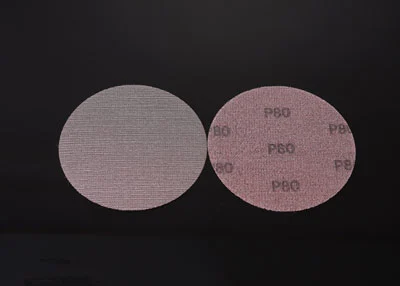
For hook-and-loop discs, the attachment system is another practical consideration. The disc should sit securely and evenly on the backing pad. Poor alignment, damaged attachment areas, or an unsuitable pad can contribute to vibration and inconsistent contact.
When evaluating automotive sanding discs, it is therefore useful to consider the entire construction rather than focusing only on grit. Two discs with the same nominal grit can behave differently because their grain structure, backing, coating, and manufacturing quality are different.
Fujistar Abrasives develops abrasive products for different sanding and surface-treatment requirements. Buyers comparing options for automotive applications can explore abrasive products for different materials and applications to identify a configuration that better fits their sanding process.
Many sanding defects are not caused by the abrasive alone. They often result from a mismatch between abrasive selection, machine settings, operator technique, and the condition of the surface.
Deep or visible scratches can occur when an abrasive is too aggressive for the current sanding stage or when the previous scratch pattern has not been sufficiently refined. A controlled progression through suitable grits can reduce this problem.
Uneven sanding may develop when pressure is concentrated in one area of the disc. This can be especially noticeable on curved automotive panels. Maintaining consistent contact and allowing the abrasive to perform the cutting work can help produce a more uniform result.
Clogging is another frequent concern, particularly when sanding coatings that generate substantial dust or debris. Effective dust extraction and a suitable disc design can help keep the abrasive surface more open during use.
Premature disc wear can indicate that the abrasive is being used under unsuitable conditions. Excessive pressure, heat, an inappropriate grit, poor dust removal, or a mismatch between the abrasive and workpiece can all shorten useful life.
Operators should also avoid relying on visual appearance alone when deciding whether a disc is still performing effectively. A disc may look usable while its cutting response has already declined. Monitoring sanding time, surface consistency, scratch quality, and material-removal behavior provides a more useful indication of abrasive performance.
For automotive refinishing businesses with specific coating systems or production requirements, abrasive selection may require more than choosing a standard grit. Fujistar Abrasives can help buyers evaluate their requirements more specifically. Users can discuss their automotive sanding requirements with the Fujistar Abrasives team and provide information about the workpiece, coating layer, equipment, sanding objective, and expected finish.
Choosing the right automotive sanding discs is fundamentally about matching abrasive behavior to the job being performed. Primer may require efficient leveling, paint often demands controlled preparation and blending, while clear coat calls for greater attention to surface refinement and material removal.
Grit selection, sanding pressure, machine conditions, disc coating, backing construction, and dust management all influence the final result. Instead of asking which disc is universally “best,” automotive refinishing professionals should consider which abrasive provides the right balance of cutting efficiency, surface control, consistency, and service life for a particular stage.
High-quality automotive abrasives can contribute to a more predictable sanding process, but the best results come when product selection and sanding technique work together. A well-matched abrasive system can reduce unnecessary rework, improve surface preparation, and support a more efficient refinishing workflow.
The appropriate grit depends on the condition of the primer and the required surface finish. Coarser grits are generally used for stronger leveling, while medium and fine grits can refine the surface before subsequent coating steps.
It is possible in some applications, but the same grit and disc construction may not be optimal for both. Primer and clear coat typically have different sanding objectives, so abrasive selection should be based on the specific process stage.
Reduced performance can result from abrasive wear, clogging, excessive heat, unsuitable pressure, or a mismatch between the disc and workpiece.
Not necessarily. Excessive pressure can increase heat and wear while producing an inconsistent surface. Controlled pressure often provides a better balance between cutting performance and finish quality.
Use a suitable grit progression, maintain consistent pressure, control machine conditions, ensure effective dust extraction, and select a disc construction appropriate for the coating and surface.
Consider the coating layer, surface condition, material-removal requirement, machine, backing pad, dust-control setup, and desired finish. For specialized applications, discussing the complete sanding process with an abrasive supplier can help narrow the selection.