In 2026, mold and die shops are operating under tighter geometric tolerances, stricter surface specifications, and shorter lead times than ever before. The pressure to deliver tooling that fits correctly on the first spotting check — without multiple rounds of hand correction — is real, and the cost of getting it wrong is high. A single rework cycle on a high-value cavity insert can consume hours of bench time and push a delivery date.
Yet one of the most persistent sources of geometry error in mold and die finishing is not a machining problem. It is a hand finishing problem. When technicians use loose sandpaper wrapped around their fingers to work flats, parting lines, and sharp edges, the pressure distribution is inherently uneven. Fingers create localized high-pressure zones that remove more material at the contact points than at the surrounding areas. On a flat surface, the result is a slightly dished or crowned plane that does not seat correctly. On a sharp edge, the result is edge collapse — the crisp 90-degree geometry that the machining operation produced is rounded off by the finishing operation that was supposed to refine it.
A grinding cube solves this by introducing physical rigidity into the hand finishing process. The flat faces of the cube distribute pressure across a defined contact area rather than concentrating it at finger contact points. The edges of the cube provide a controlled reference geometry that helps maintain true angles during finishing. For mold and die benchwork where geometric accuracy is the primary requirement, the grinding cube is the tool that makes hand finishing repeatable rather than operator-dependent.
The working principle of a grinding cube is straightforward, but its implications for mold and die finishing are significant. The difference between hand finishing with loose sandpaper and hand finishing with a grinding cube is the difference between a compliant contact and a rigid one.
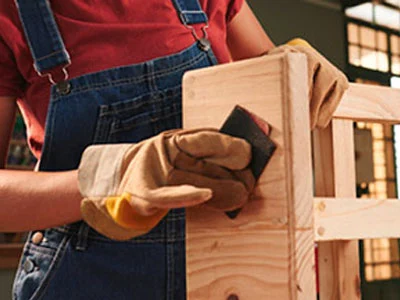
When a technician wraps sandpaper around their fingers and works a flat surface, the contact geometry is determined by the shape of the fingers, not the shape of the workpiece. Fingers are rounded, and they flex under pressure. The abrasive contact is concentrated at the peaks of the finger profile — typically the fingertip and the first knuckle — and the pressure drops off rapidly toward the edges of the contact zone.
On a flat surface, this uneven pressure distribution removes more material at the high-pressure contact points than at the surrounding areas. Over multiple passes, the surface develops a slight dish or crown that is difficult to detect by eye but shows up immediately on a bluing check or a straightedge inspection. Correcting a dished surface requires removing material from the high areas, which often means additional passes that risk introducing new geometry errors.
On a sharp edge — the corner of a parting line, the edge of a shutoff surface, the corner of a cavity pocket — the problem is more severe. The rounded finger profile cannot maintain contact at the exact corner geometry. Pressure is applied to the faces on either side of the corner rather than at the corner itself, and the abrasive action rounds the corner progressively with each pass. The crisp 90-degree edge that the machining operation produced becomes a radius that may be outside the tolerance for the feature. In mold work, a rounded shutoff edge that should be sharp is a direct cause of flash on the molded part.
A grinding cube provides a flat, rigid contact face that does not deform under hand pressure. When the cube face is held flat against the workpiece surface, the pressure is distributed across the full contact area of the cube face rather than concentrated at finger contact points. The abrasive action is uniform across the contact zone, which means material is removed evenly from the workpiece surface rather than preferentially at high-pressure points.
The edges of the cube serve as a controlled reference geometry for corner and edge work. When the cube is oriented with one face flat on a surface and an adjacent face against a perpendicular surface, the cube edge defines the corner geometry. The abrasive action at the corner is controlled by the cube geometry rather than by the shape of the operator's fingers, which means the corner angle is maintained rather than rounded.
The result is a hand finishing process that is more consistent across passes, more consistent across technicians, and more predictable in its effect on workpiece geometry. The scratch pattern produced by the cube face is uniform, which means the downstream polishing steps start from a more consistent surface condition and require fewer passes to reach the final specification.
Selecting the right grinding cube configuration for a mold and die application requires matching the cube's physical properties to the geometry of the feature being finished and the material being worked.
The stiffness of the grinding cube is the property that determines how effectively it maintains flat contact under hand pressure. A cube that is too soft will deform under pressure, partially conforming to the workpiece surface and losing the flat contact geometry that is the cube's primary advantage over loose sandpaper. A cube that is appropriately stiff maintains its geometry under the pressure range used in hand finishing, ensuring that the contact face remains flat throughout the working stroke.
Stiffness selection should be matched to the material hardness and the amount of stock to be removed. For hardened tool steel — the most common material in mold and die work — a higher stiffness cube is appropriate because the material resists cutting and the operator needs to apply meaningful pressure to achieve useful removal rates. For softer materials or light refinement passes where pressure is low, a moderately stiff cube is sufficient.
The grit selection determines the balance between material removal rate and surface finish quality at each stage of the finishing process. Coarser grits are appropriate for removing EDM recast layer, tool marks from machining, and small geometry mismatches that need to be corrected before the surface can be refined. Finer grits refine the scratch pattern left by the coarser step, preparing the surface for polishing or coating.
The grit sequence should be designed to use the fewest steps that achieve the required surface condition. Each additional grit step adds bench time. For most mold and die benchwork, a two-step sequence — removal and refinement — covers the full range from correcting machining marks to preparing for polishing. A three-step sequence is appropriate when the starting surface condition is rough and the final surface specification is tight.
Stepping down through grits systematically is important for avoiding the situation where deep scratches from a coarse grit are chased through multiple fine grit passes. Each grit step should remove the scratch pattern from the previous step completely before moving to the next finer grit.
The physical size of the grinding cube determines the balance between access to tight features and stability on larger flat surfaces. Smaller cubes reach into tight pockets, narrow slots, and confined corner geometries where a larger cube cannot fit. Larger cubes provide a wider contact face that improves stability and flatness on larger flat surfaces — a wider contact face is less susceptible to rocking than a narrow one.
For most mold and die benchwork, having two cube sizes available — a smaller cube for tight features and a larger cube for open flats and parting lines — covers the full range of finishing tasks without requiring a compromise between access and stability.
The edge profile of the cube — whether the edges are sharp or slightly broken — affects how the cube performs on corner work. A sharp cube edge is appropriate when the goal is to maintain or define a crisp corner geometry. A slightly broken edge is appropriate when the goal is controlled blending at a transition rather than maintaining a sharp corner.
The grinding cube creates the most significant performance difference in the finishing operations where geometric accuracy is the primary requirement and where loose sandpaper's uneven pressure distribution is the primary source of error.
Parting lines and shutoff surfaces are the features where flatness and edge sharpness have the most direct effect on part quality. A parting line that is not flat causes mismatch between the two halves of the mold, which shows up as a visible step on the molded part. A shutoff surface that is not flat or whose edges are rounded allows plastic to flow into areas where it should be blocked, creating flash that requires trimming and may cause part rejection.
The grinding cube maintains flatness on parting line surfaces by distributing pressure evenly across the contact face, preventing the dishing that loose sandpaper creates. The cube edge maintains the sharpness of shutoff edges by providing a controlled reference geometry that prevents the rounding that finger pressure causes. For these features, the grinding cube is not a convenience — it is the tool that makes the finishing operation geometrically reliable.
Inside corners and cavity edges in mold work define the geometry of the molded part. A corner that is rounded beyond the tolerance for the feature produces a part with a radius where there should be a sharp corner, or a blend radius that is larger than specified. Correcting that error on the mold requires removing material from the faces adjacent to the corner to restore the correct geometry — a correction that is time-consuming and risks introducing new errors.
The grinding cube maintains corner definition by providing a rigid reference edge that controls the abrasive action at the corner. The cube edge does not round the corner — it defines it. For cavity edges where geometric fidelity drives part quality, the cube is the appropriate finishing tool.
After machining and EDM operations, mold components typically require hand finishing to remove the recast layer left by EDM, correct minor tool marks, and bring the surface to the specification required for polishing. This benchwork is where the grinding cube's combination of rigidity and controlled grit sequence delivers the most consistent results.
Loose sandpaper on EDM surfaces tends to follow the existing surface texture rather than correcting it, because the sandpaper conforms to the surface rather than cutting across it uniformly. The grinding cube's rigid face cuts across the surface texture consistently, removing the recast layer and tool marks without introducing new contour errors from uneven finger pressure.
Specifying the right grinding cube for a mold and die application requires a structured approach that matches the cube's properties to the specific finishing task.
Start by defining the surface type and the finishing objective. A flat parting line surface requires a cube size that provides stable flat contact across the full feature width. A tight inside corner requires a smaller cube that fits into the corner geometry. A cavity edge that must remain sharp requires a cube with a sharp edge profile. Identifying the surface type and objective before selecting the cube prevents the common mistake of using a single cube specification for all finishing tasks regardless of geometry.
Identify the defect type that needs to be removed. EDM recast layer, machining tool marks, and small geometry mismatches each require different starting grits. EDM recast layer is hard and requires a coarser starting grit than a light tool mark on a pre-hardened surface. Matching the starting grit to the defect type avoids the situation where the first grit step is too fine to remove the defect efficiently, leading to extended bench time and the risk of introducing geometry errors from prolonged abrasive contact.
Set the tolerance risk for the feature. Features with tight flatness requirements or sharp edge specifications need more careful grit progression and more frequent inspection than features with looser tolerances. Defining the tolerance risk before starting the finishing operation establishes the inspection frequency and the stopping criterion for each grit step.
Validate the result with appropriate inspection. A bluing check or straightedge inspection confirms flatness. A visual inspection under raking light confirms scratch pattern uniformity. A microscope inspection confirms edge geometry on critical features. Building inspection checkpoints into the finishing workflow prevents the situation where geometry errors are discovered at the final inspection stage after significant bench time has been invested.
Keep the cube face flat to the surface throughout the working stroke. Rocking the cube — allowing one edge to lift during the stroke — concentrates pressure at the leading edge and produces a tapered scratch pattern rather than a uniform one. A consistent flat contact throughout the stroke is the technique requirement that makes the cube's pressure distribution advantage effective.
Rotate the cube periodically to distribute wear across all faces. A cube that is used exclusively on one face develops uneven wear that reduces the flatness of the contact surface over time. Rotating the cube extends its effective life and maintains the flat contact geometry that is its primary advantage.
Use controlled stroke length and direction. Short, controlled strokes with consistent direction produce a more uniform scratch pattern than long, variable strokes. On flat surfaces, overlapping strokes that cover the full feature area ensure that no areas are under-sanded relative to the rest of the surface.
The cost argument for grinding cubes in mold and die finishing is built on rework avoidance. The relevant comparison is not the cost of a grinding cube versus a sheet of sandpaper — it is the cost of a rework cycle on a high-value tooling component versus the cost of getting the geometry right on the first finishing pass.
Geometry-related rework in mold and die work is expensive in proportion to the value of the component being finished. A rounded shutoff edge that causes flash requires the mold to be pulled from the press, the edge to be corrected, and the mold to be re-qualified before production resumes. The total cost of that cycle — press downtime, bench time, re-qualification — is many times the cost of the abrasive consumables used in the finishing operation.
Reducing the frequency of geometry-related rework cycles is the primary source of ROI from grinding cubes. Fewer rounded edges, fewer dished parting lines, and fewer uneven flats mean fewer spotting cycles, fewer polishing rework loops, and fewer corrections after the mold goes to the press. Each rework cycle avoided is a direct cost saving that is large relative to the consumable cost of the grinding cube.
The secondary source of ROI is consistency across technicians. When hand finishing results depend on individual operator technique, the quality of the finished tooling varies with who is doing the finishing. A grinding cube reduces that variability by providing a physical reference geometry that constrains the finishing process regardless of individual technique differences. More consistent results across technicians means more predictable bench time per feature and fewer surprises at the inspection stage.
Track minutes per feature — flat surface, shutoff edge, inside corner — before and after introducing grinding cubes into the finishing workflow. Track rework loops attributable to geometry errors — rounded edges, uneven flats, mismatch at parting lines — separately from other rework causes. Track the number of spotting cycles required per tool before the mold achieves acceptable fit. These three metrics, measured over one to two weeks of production finishing work, give a clear picture of the time and cost savings that the grinding cube delivers in the specific shop environment.
In mold and die finishing, the most costly errors are often the smallest ones — a slightly rounded shutoff edge, a marginally dished parting line, an inside corner that is a few hundredths of a millimeter off geometry. These errors do not come from machining. They come from the hand finishing step, where loose sandpaper and finger pressure introduce the variability that precise machining worked to eliminate.
A grinding cube adds the missing variable: rigidity. The flat face distributes pressure evenly across the contact area, preventing the dishing and rounding that finger pressure causes. The cube edge provides a controlled reference geometry for corner and edge work, maintaining the crisp angles that mold geometry requires. The result is a hand finishing process that is more consistent, more predictable, and less dependent on individual operator technique — which means fewer rework cycles, faster bench time per feature, and more reliable first-time fit at the spotting stage.
To receive a recommended cube size, grit configuration, and quotation, visit the grinding cube product page and submit the following details:
Operating conditions: mold or die material, feature type (flat surface, sharp edge, inside corner, or tight pocket), hand finishing only or tool-assisted
Quantity: trial quantity, monthly usage volume, number of benches or technicians
Size and specs: preferred cube dimensions, grit range and sequence, any access constraints such as minimum pocket width
Target metrics: flatness target, allowable edge radius, surface finish target expressed as Ra, time-to-finish goal per feature
Current problems: edge collapse on shutoff surfaces, uneven parting line planes, excessive spotting cycles, polishing rework from inconsistent scratch patterns, variable results between technicians
Q1: What is a grinding cube?
A grinding cube is a rigid, block-shaped abrasive tool used for hand finishing in precision metalworking applications, particularly mold and die work. Its flat faces and defined edges provide a controlled contact geometry that distributes hand pressure evenly across the workpiece surface, preventing the uneven removal and edge rounding that occur when loose sandpaper is used with finger pressure. It is used for finishing flat surfaces, maintaining sharp edges, working inside corners, and removing EDM recast layer and machining marks in benchwork operations.
Q2: What is the difference between a grinding cube and loose sandpaper for mold finishing?
Loose sandpaper conforms to the shape of the fingers holding it, concentrating pressure at finger contact points and rounding edges and corners progressively with each pass. A grinding cube provides a rigid, flat contact face that distributes pressure uniformly across the contact area, maintaining flat surfaces and crisp corner geometry throughout the finishing operation. The practical difference is fewer geometry errors — rounded edges, dished flats, uneven parting lines — and more consistent results across different technicians performing the same finishing task.
Q3: What is the ROI of using grinding cubes in mold and die finishing?
The return on investment comes primarily from reduced rework cycles. Geometry errors introduced during hand finishing — rounded shutoff edges, uneven parting lines, dished flat surfaces — require correction cycles that consume significant bench time and may require the mold to be pulled from the press for rework. Each rework cycle avoided by using a grinding cube to maintain geometric accuracy during the initial finishing operation saves bench time, press downtime, and re-qualification time that is many times the cost of the abrasive consumable. Secondary ROI comes from more consistent results across technicians and faster bench time per feature from a more controlled finishing process.
Q4: Do we need to modify equipment or workflow to use grinding cubes?
No equipment changes are required. Grinding cubes are designed for manual benchwork and fit into existing finishing workflows without modification. The workflow changes that improve results are procedural: standardizing the grit sequence for each feature type, establishing inspection checkpoints at each grit step, and training technicians on the technique requirements — keeping the cube face flat, rotating the cube to distribute wear, and using controlled stroke patterns. These changes can be incorporated into standard work instructions without capital investment.
Q5: What parameters should we provide for accurate selection and quoting?
For the most useful recommendation, provide the tool steel type and hardness, the feature geometry being finished (flat surface, sharp edge, inside corner, or tight pocket), any access constraints such as minimum pocket width or corner radius, the defect type to be removed (EDM recast layer, machining tool marks, or geometry mismatch), the target surface finish expressed as Ra, the flatness requirement, the allowable edge radius, the preferred cube size if known, and the expected usage volume per month. The more specific the inputs, the more accurate the cube size and grit sequence recommendation.