In body shop production, airborne dust is not a housekeeping problem — it is a quality and compliance problem. Primer and filler dust that recirculates under a sanding disc causes fisheyes, nibs, and random deep scratches that only become visible after topcoat, forcing rework on panels that were otherwise correctly prepared. At the same time, occupational health scrutiny around respirable silica and paint dust is increasing under OSHA and HSE frameworks, putting shops under pressure to demonstrate active dust control rather than relying on respirators alone.
For procurement managers sourcing sanding discs at volume, the choice of hole pattern and extraction compatibility has moved from a technical footnote to a direct quality and compliance variable. Choosing the right sanding disc — and qualifying consistent wholesale sanding discs that match the extraction setup across every stall — is now a production decision with measurable impact on rework rate, disc consumption, and regulatory readiness.
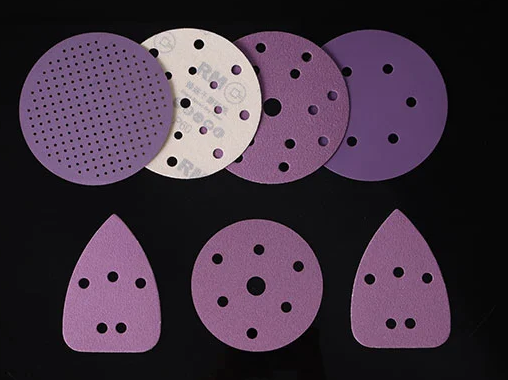
A standard sanding disc with a limited hole pattern creates dead zones — areas of the disc face where dust generated at the cutting zone has no direct extraction path. Dust in these zones recirculates under the disc, accumulates between abrasive grains, and either loads the disc prematurely or gets dragged across the panel surface as a secondary abrasive, creating random deep scratches inconsistent with the intended grit.
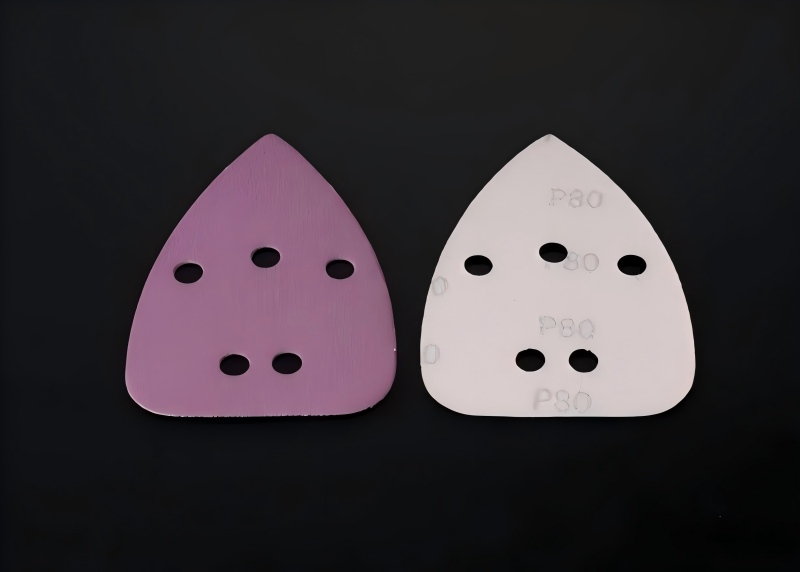
A multi-hole or mesh sanding disc distributes extraction inlets across the full disc face, eliminating dead zones and pulling dust away from the cutting zone continuously. Three results follow: the abrasive surface stays cleaner and cuts more consistently, the dust cloud above the work surface is reduced, and heat at the cutting zone is lower because loaded grains are replaced by clean cutting edges rather than rubbing against accumulated swarf.
| Condition | Standard Hole Pattern | Multi-Hole Pattern |
|---|---|---|
| Dust removal from cutting zone | Partial — dead zones trap dust | Continuous — full-face extraction |
| Abrasive loading rate | Higher | Lower |
| Secondary scratch risk | Higher — trapped particles drag across panel | Lower — dust exits before accumulating |
| Heat generation | Higher — loaded grains rub rather than cut | Lower — active cutting maintained longer |
| Disc life per unit | Shorter | Longer |
| Airborne dust level | Higher | Significantly reduced |
View Fuji Star multi-hole sanding disc options and specifications on the Sanding Discs product page.
Ordering wholesale sanding discs without confirming extraction compatibility replicates the same dust and quality problems at higher volume. The following specifications determine whether the disc delivers its extraction performance in the specific shop setup.
| Specification | What to Confirm | Impact |
|---|---|---|
| Disc diameter and attachment type | Hook and loop or PSA matched to pad and duty cycle | Incorrect attachment reduces pad seal and extraction efficiency |
| Hole pattern compatibility | Disc holes align with pad pattern | Misalignment blocks airflow and negates multi-hole benefit |
| Abrasive grain type | Matched to substrate — filler, primer, paint, or metal | Wrong grain increases clogging rate and defect risk |
| Grit range and progression | Controlled step-down from filler to refinement | Prevents scratch carryover into topcoat stages |
| Anti-loading coating | Specified for filler and primer dust | Extends disc life and maintains cut rate between changes |
| Backing weight and edge stability | Appropriate for orbital speed and contact pressure | Prevents tearing and maintains flat contact at speed |
| Batch consistency and packaging | Lot marking, consistent cut rate, protective packaging | Reduces rework from variable disc performance across shifts |
For shops sourcing wholesale sanding discs across multiple stalls and shifts, batch-to-batch consistency is the specification that most directly affects quality stability. Require lot traceability, standardized labeling, and documented grit distribution tolerance from any wholesale supplier before approving them for production use.
Primer generates the highest dust volumes per square meter of any body shop sanding stage. Without effective extraction, primer dust loads the disc within minutes, reducing cut rate and increasing the risk of dragging accumulated particles across the surface. Multi-hole discs with anti-loading coating maintain cutting efficiency significantly longer, reducing disc consumption per repair order and keeping the scratch pattern consistent through the full sanding pass.
Filler dust is coarse, heavy, and settles quickly on adjacent surfaces. Effective extraction during filler shaping reduces the amount of dust that settles on panels being prepared in adjacent stalls — a common source of contamination defects that appear after topcoat on panels not directly involved in the filler work.
At blend prep and panel finishing stages, dust tolerance is lowest. Any particle that settles on a prepared surface before topcoat application is a potential nib or fisheye. Multi-hole extraction at this stage reduces the airborne particle count in the immediate work area, lowering the probability of contamination defects on panels ready for the spray booth.
In enclosed preparation areas, dust that is not captured by extraction recirculates and settles on every surface in the bay — including panels already prepared. Effective multi-hole extraction reduces the total dust load in the enclosed space, protecting adjacent work and reducing booth cleaning frequency between jobs.
Less airborne dust supports respirator programs by lowering the baseline exposure level that respirators must compensate for. It also improves operator visibility during sanding — particularly during filler shaping and primer work — which directly affects the consistency of the sanding result across long shifts.
Follow these four steps before committing to a disc specification across the shop:
First, confirm the sander pad hole pattern and pad condition. A worn pad with compressed foam or damaged hooks reduces both the mechanical seal between disc and pad and the airflow through extraction holes — negating the benefit of a multi-hole disc regardless of its design.
Second, verify vacuum airflow and hose condition. Kinked hoses, clogged filters, and undersized vacuum units reduce the extraction pressure that drives dust through the disc holes. A multi-hole disc on a poorly maintained vacuum will not outperform a standard disc on a correctly maintained system.
Third, choose multi-hole discs that align with the pad pattern, or select compatible multi-hole patterns designed for broader pad compatibility to reduce SKU complexity across different sander models in the shop.
Fourth, standardize grit ladders and disc change criteria by job stage. Filler shaping, primer sanding, and refinement each have different dust volumes, loading rates, and scratch requirements. A single grit ladder applied to all stages is a common source of both disc waste and finish defects.
Run a side-by-side comparison on the same repair area — standard hole pattern versus multi-hole disc, same grit, same vacuum. Measure dust on the panel surface after sanding, disc loading rate at the end of the pass, scratch uniformity under inspection lighting, and time to complete the pass. The results provide a direct, operation-specific ROI baseline before committing to a wholesale order.
The unit price of a multi-hole disc is typically comparable to or marginally higher than a standard disc. The relevant comparison is total cost per repair order — which includes disc consumption, rework labor, cleanup time, and vacuum maintenance.
| Cost Source | Standard Disc | Multi-Hole Disc |
|---|---|---|
| Disc life per repair order | Shorter — loading accelerates failure | Longer — extraction keeps surface open |
| Rework from secondary scratches | Higher | Lower |
| Cleanup labor per shift | Higher — more dust settles on surfaces | Lower — extraction captures dust at source |
| Vacuum filter replacement | Higher — more dust bypasses disc | Lower — more dust captured through disc |
| Total cost per repair order | Often higher | Usually lower |
| Metric | What It Reveals |
|---|---|
| Discs consumed per repair order | True disc cost per unit of output |
| Rework hours from finish defects | Quality impact of dust and loading |
| Cleanup labor minutes per shift | Hidden labor cost of poor extraction |
| Vacuum filter replacement frequency | System health and extraction efficiency |
Body shop dust control directly impacts both finish quality and worker health. Multi-hole sanding disc systems improve extraction by pulling dust away from the cutting zone continuously, keeping the abrasive surface cleaner, reducing secondary scratches, and lowering airborne dust exposure across the shift. When paired with the correct pad pattern, a properly maintained vacuum system, and a controlled grit progression, consistent wholesale sanding discs become a measurable lever for efficiency, compliance readiness, and lower total rework cost per repair order.
The right sanding disc specification starts with your substrate, your extraction setup, and your current defect pattern. Share the details below and Fuji Star will recommend the correct hole pattern, grit progression, and anti-loading specification — with pricing matched to your wholesale volume.
Visit the Fuji Star sanding disc product page to view options and submit your inquiry: Sanding Discs
Work conditions: Substrate at each sanding stage (filler, primer, paint, or metal), dry sanding process, stall or booth setup, and shift length.
Quantity: Monthly disc consumption, trial quantity, annual forecast, and wholesale packaging preference.
Size and spec: Disc diameter, attachment type (hook and loop or PSA), pad hole pattern, grit range required, and anti-loading requirement.
Target metrics: Finish defect reduction goal, disc life target, time-per-panel target, and dust exposure reduction goal.
Current problem: Fisheyes or nibs after topcoat, heavy airborne dust, rapid disc clogging on primer or filler, secondary scratches from trapped particles, or vacuum not performing as expected with current disc pattern.
Q1. What is a sanding disc?
A sanding disc is a circular abrasive product used on orbital and dual-action sanders to remove material, level surfaces, and prepare panels for refinishing. Sanding discs are available in a range of diameters, hole patterns, abrasive grain types, grit sizes, and attachment systems — hook and loop or PSA — for use across the full range of body shop sanding stages from filler shaping through final refinement before topcoat.
Q2. How do multi-hole sanding discs compare with standard hole patterns?
Multi-hole discs distribute extraction inlets across the full disc face, eliminating the dead zones where dust accumulates under standard hole patterns. The practical result is lower loading rate, longer disc life, fewer secondary scratches from trapped particles, and reduced airborne dust in the work area. Standard hole patterns can perform adequately on low-dust substrates or with high-flow extraction systems, but on primer and filler — the highest dust-volume stages in body shop production — multi-hole designs consistently outperform standard patterns on disc life and finish quality.
Q3. How do we calculate ROI from switching to multi-hole wholesale sanding discs?
Track four metrics before and after the switch: discs consumed per repair order, rework hours attributed to finish defects, cleanup labor minutes per shift, and vacuum filter replacement frequency. Convert each to a monthly cost and compare the total before and after, subtracting any difference in disc unit cost. In most body shop environments with significant primer and filler sanding volume, the reduction in disc consumption and rework labor produces a positive ROI within the first month of use.
Q4. Do we need to modify tools to use multi-hole discs?
No major tool modifications are required. The primary requirement is a backing pad with a hole pattern that aligns with the disc — misaligned holes block airflow and negate the extraction benefit. Many multi-hole disc designs are compatible with a range of pad patterns to reduce this risk. A properly functioning vacuum system with clean filters and unkinked hoses is equally important — the disc design improves extraction efficiency, but it cannot compensate for a vacuum system that is not delivering adequate airflow.
Q5. What parameters should we provide to select the right wholesale sanding discs?
Provide the following: disc diameter and attachment type, current pad hole pattern and sander model, substrate and process stage for each sanding operation (filler, primer, blend prep, or metal), grit progression currently in use, dust extraction setup including vacuum brand and airflow rating, monthly disc consumption volume, and the primary current problem — fisheyes or nibs after topcoat, rapid disc clogging, secondary scratches, heavy airborne dust, or inconsistent finish quality between operators or shifts.