In 2026, heavy-duty manufacturers are being squeezed from both sides. The materials getting harder — stainless steel, high-strength structural alloys, titanium — while takt time targets tighten and labor costs climb. Procurement is expected to hold consumables spend flat or reduce it. Against that backdrop, the question of whether ceramic sanding discs are worth two to three times the unit price of zirconia alternatives comes up in every serious abrasive review. The hesitation is understandable. A disc that costs significantly more per unit is a hard sell when the budget conversation starts and ends at price per piece. But the operations teams running stainless fabrication lines, weld blending stations, and high-alloy finishing cells are increasingly finding that the unit price comparison is the wrong frame. The relevant number is cost per finished part — and that calculation includes disc consumption rate, changeover downtime, time-to-finish, and rework from inconsistent cut quality. This guide explains the mechanism behind ceramic abrasive performance, where it creates a genuine advantage over zirconia in demanding metalwork, and how to structure a trial that produces the cost-per-part data needed to make the decision defensible.
The performance difference between ceramic and zirconia abrasives is not a matter of marketing positioning. It is a difference in how the abrasive grain behaves under the mechanical and thermal stress of heavy-duty grinding and blending.
Conventional abrasive grains — including zirconia — wear by a process of progressive dulling. The cutting edges of the grain round off under repeated contact with the workpiece. As the edges dull, the grain generates more friction and less cutting action. Cut rate drops. The operator compensates by pressing harder, which generates more heat, accelerates grain dulling further, and eventually produces a disc that is generating heat and friction without removing material at a useful rate. Ceramic abrasive grains are engineered to behave differently. Under the mechanical stress of grinding, ceramic grains micro-fracture — they break along controlled internal planes, exposing fresh sharp cutting edges as the worn surface is shed. This is not random grain breakdown. It is a designed wear mechanism that continuously renews the cutting surface throughout the disc's usable life. The practical result is a cut rate that remains more stable from the beginning of the disc's life to near the end, rather than starting high and declining rapidly as the grain dulls. On a long weld blending pass or a sustained stock removal operation, that stability means the operator is working with a consistently sharp abrasive rather than compensating for a progressively duller one.
Hard metals — stainless steel, titanium, high-strength alloys — are the conditions where the difference between ceramic and zirconia is most pronounced. These materials resist cutting, generate significant heat at the abrasive interface, and punish dull grains quickly. A zirconia disc that performs adequately on mild steel may dull rapidly on stainless, reaching the point where it is generating heat rather than cutting material well before its physical abrasive surface is spent. Ceramic's micro-fracturing mechanism is particularly valuable in these conditions because it maintains sharp cutting edges even as the grain is subjected to the elevated temperatures and pressures that hard metals generate. The disc continues to cut rather than glazing, which means less heat transferred to the workpiece — an important consideration on stainless steel where heat discoloration is a quality issue — and less operator fatigue from compensating for a dull abrasive.
The unit price difference between ceramic and zirconia is visible immediately. The specification differences that determine whether ceramic delivers its performance advantage in your specific application require a closer look.
Ceramic abrasive is available in different grain densities and formulations that affect the balance between aggressive stock removal and finish consistency. Higher grain density delivers faster cut rate for stock removal and weld blending. Lower density with finer grit provides better finish control for pre-inspection surface preparation. Specifying the right grain density for each stage of the process — rather than using a single disc specification across all stages — is part of capturing the full ROI of ceramic abrasive. Zirconia is a capable abrasive in many heavy-duty applications and performs well in moderate-pressure grinding on a range of metals. The performance gap between zirconia and ceramic widens as material hardness increases, pressure increases, and heat becomes a limiting factor. In those conditions, zirconia's grain dulling accelerates and the cut rate decline becomes a throughput problem.
The backing material — fiber, film, or cloth — determines how the disc handles pressure transfer and edge stress. In weld blending and beveling operations, the disc edge is subjected to significant lateral stress as it works along weld toes and transitions. A backing that breaks down at the edge prematurely ends the disc's useful life regardless of how much abrasive grain remains on the face. Fiber backings provide stiffness that transfers pressure efficiently in high-downforce applications. Film backings offer more consistent thickness and flatness for finish-critical work. The backing selection should match the mechanical demands of the application — a backing that is too flexible for high-pressure grinding will not transfer force efficiently, and a backing that is too rigid for contour work will not maintain contact on curved surfaces.
Heat management is a critical specification variable for stainless steel and titanium work. Discoloration on stainless — the blue and gold heat tints that appear when the surface temperature exceeds certain thresholds — is a quality defect that requires additional finishing work to address. An abrasive that generates less heat through more efficient cutting reduces the risk of discoloration and the rework it creates. Anti-loading treatments on the abrasive surface reduce the accumulation of swarf between grains, which is a secondary source of heat and cut rate reduction. For applications where the workpiece material is prone to loading — aluminum, softer alloys, painted surfaces — anti-loading specification is an important part of maintaining the cut rate that ceramic's micro-fracturing is designed to deliver.
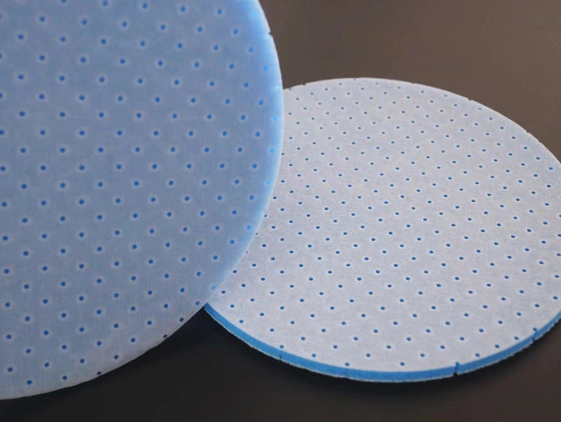
The hole pattern on the disc affects dust extraction efficiency, which in turn affects heat buildup and loading. A hole pattern that aligns with the extraction ports on the backing pad allows swarf to be removed from the cutting zone continuously, keeping the abrasive surface cleaner and reducing the thermal load at the interface. For applications where dust extraction is in use, confirming that the disc hole pattern is compatible with the pad and extraction system is a straightforward step that protects the performance investment in ceramic abrasive. PSA and hook-and-loop attachment each have operational implications for changeover speed and disc repositioning. Hook-and-loop allows the disc to be removed and repositioned, which is useful when a disc is being used across multiple operations. PSA provides a more secure bond for high-vibration applications but does not allow repositioning once attached.
The applications where ceramic creates the most significant performance and cost-per-part advantage are those where material hardness, heat generation, and changeover frequency are the primary variables driving total cost.
Stainless steel is the application where the ceramic versus zirconia comparison is most frequently made and most clearly resolved in ceramic's favor. Stainless resists cutting, work-hardens under pressure, and is sensitive to heat discoloration. A zirconia disc on stainless steel typically shows a rapid cut rate decline as the grain dulls against the hard, work-hardened surface. The operator pushes harder to maintain removal rate, which generates more heat, accelerates dulling further, and increases the risk of discoloration. Ceramic's micro-fracturing maintains sharp cutting edges against the work-hardened stainless surface, delivering more consistent material removal with less heat generation. Weld blending passes that require multiple disc changes with zirconia can often be completed with fewer changes using ceramic, and the surface condition at the end of the pass is more consistent — reducing the finishing work required before inspection.
Titanium is one of the most demanding materials for abrasive performance. It is hard, generates significant heat at the cutting interface, and is sensitive to contamination from abrasive grain shedding. The sustained sharpness of ceramic abrasive is particularly valuable on titanium because the material's resistance to cutting means that any reduction in grain sharpness translates immediately into reduced removal rate and increased heat. For high-strength alloys used in structural and aerospace fabrication, the same logic applies. The harder the material, the more valuable the micro-fracturing mechanism becomes, because the conditions that accelerate grain dulling in conventional abrasives are exactly the conditions that ceramic is designed to handle.
Shipbuilding, heavy equipment fabrication, and structural steel work involve high downforce, long continuous grinding passes, and significant weld volumes per shift. In these environments, disc changeovers are disruptive — stopping the grinder, removing the worn disc, attaching a new one, and resuming the pass takes time that accumulates across a shift. If ceramic reduces the number of changeovers required to complete a defined amount of work, the labor saving is real and measurable. The stability of ceramic's cut rate also reduces operator fatigue. When the abrasive maintains consistent cutting action, the operator does not need to compensate for a dulling disc by adjusting pressure and technique continuously. More consistent technique produces more consistent surface quality, which reduces the rework rate from finish variation.
Specifying ceramic sanding discs correctly and setting up the process to capture their performance advantage requires matching the product to the application and standardizing the operating conditions that affect disc life.
Ceramic sanding discs are the right choice when the material is hard — stainless steel, titanium, high-strength alloys — and the process involves high pressure, sustained grinding passes, or significant heat generation. When the primary bottleneck is disc changeover frequency, inconsistent cut rate across a shift, or operator fatigue from compensating for dulling abrasives, ceramic's micro-fracturing mechanism addresses those problems directly. Zirconia remains a strong choice when the material is less demanding — mild steel, aluminum, softer alloys — and the removal rate requirement is moderate. In those conditions, the performance gap between ceramic and zirconia narrows, and the unit price difference is harder to recover through reduced consumption and changeover savings. The decision should be based on the specific material and process conditions, not on a blanket preference for either abrasive type.
Use the fewest grit steps that still achieve the required surface condition. Each additional grit step adds changeover time and abrasive cost without proportional quality improvement if the step is not genuinely necessary. For most weld blending and surface preparation workflows, a coarse grit for stock removal, a medium grit for blending, and a fine grit for finish preparation covers the full range. Standardizing the grit sequence per operation type reduces errors and makes consumption tracking meaningful.
Pair ceramic discs with effective dust extraction where the application allows. Extraction removes swarf from the cutting zone, reduces heat buildup, and extends the effective cutting life of the disc. The investment in extraction setup is recovered through longer disc life and more consistent cut rate. Standardize angle, pressure, and speed across operators. Ceramic's performance advantage is most fully realized when the operating conditions are consistent. Variable pressure and angle between operators produces variable results and makes it difficult to measure the disc's actual performance in a meaningful way. A brief operator standardization step before a trial is worth the time investment.
The cost-per-part model is the right framework for evaluating ceramic sanding discs, and it requires measuring variables beyond unit price.
Total cost equals disc spend plus the labor cost of changeovers plus rework from inconsistent finish quality plus throughput loss from dull abrasives that slow the operation. A ceramic disc that costs two to three times more per unit than zirconia can deliver a lower total cost if it reduces disc consumption, cuts changeover frequency, and maintains the cut rate that keeps the operation moving at target takt time. The following table provides a structured comparison of the two abrasive types across the variables that matter for the TCO calculation.
| Criteria | Ceramic Sanding Discs | Zirconia Sanding Discs |
|---|---|---|
| Unit price | High (2–3× zirconia) | Medium |
| Grain wear mechanism | Micro-fracturing — continuously exposes fresh cutting edges | Progressive dulling — edges round off under sustained use |
| Cut rate stability across disc life | High — more consistent from start to end of disc life | Moderate — cut rate declines as grain dulls, especially on hard metals |
| Performance on hard metals (stainless, titanium) | Strong — micro-fracturing maintains sharpness against hard, work-hardened surfaces | Moderate — dulling accelerates on hard metals, cut rate drops faster |
| Heat generation | Lower — efficient cutting reduces friction heat | Higher when dulling — dull grains generate more heat than they remove material |
| Disc changeover frequency | Lower — sustained sharpness extends usable life per disc | Higher on hard metals — more frequent changes needed as cut rate declines |
| Rework risk from inconsistent finish | Lower — stable cut rate produces more consistent scratch pattern | Moderate — cut rate variation across disc life can produce surface inconsistency |
| Cost per finished part (hard metals) | Lower in demanding applications when changeover and rework savings are captured | Higher when disc consumption and changeover frequency are factored in |
| Recommended when | Hard metals, high pressure, heat-sensitive surfaces, changeover reduction is a priority | Moderate removal demands, less demanding materials, cost-sensitive applications where ceramic premium is not recovered |
The cost-per-part advantage of ceramic sanding discs is most significant in hard-metal applications where disc changeover frequency and heat-related rework are the primary cost drivers. In moderate-demand applications, zirconia remains a competitive choice.
The claim that ceramic can deliver significantly fewer disc changes than zirconia in hard-metal applications is a target outcome to validate in a controlled trial, not a guaranteed result for every application. The actual reduction depends on the specific material, the operating pressure, the disc specification, and the process conditions. The right way to present this to procurement and operations leadership is as a trial hypothesis: in hard-metal applications under high pressure, ceramic's micro-fracturing mechanism is expected to extend disc life relative to zirconia, with the actual reduction to be measured in a structured A/B test. That framing is credible, testable, and positions the trial as a data-gathering exercise rather than a commitment to a more expensive product.
Structure the trial with the same operator, the same grinder or sander, and the same pressure range for both ceramic and zirconia. Measure discs consumed per part or per meter of weld. Measure minutes to reach the required finish standard. Record heat-related issues — discoloration, glazing, inconsistent scratch pattern. Collect operator feedback on fatigue and consistency. Track rework incidents attributable to abrasive performance. Two weeks of data from a controlled trial gives procurement a cost-per-part comparison that is specific to the operation and defensible in a budget review. It also identifies the applications where ceramic delivers the strongest ROI and the applications where zirconia remains the more cost-effective choice.
The decision to upgrade from zirconia to ceramic sanding discs in heavy-duty metalwork is not a question of whether ceramic is expensive. It is a question of whether ceramic reduces total cost by maintaining cut rate, cutting changeover frequency, and reducing rework on hard metals where zirconia dulls quickly. The micro-fracturing mechanism that defines ceramic abrasive performance is most valuable precisely in the conditions that are most common in demanding fabrication environments — hard materials, high pressure, sustained grinding passes, and heat-sensitive surfaces. In those conditions, the sustained sharpness of ceramic translates into fewer disc changes, more consistent surface quality, and a cost-per-finished-part outcome that the unit price comparison does not capture. To receive a recommended disc specification, trial plan, and quotation, visit the ceramic sanding discs product page and submit the following details:
Operating conditions: material type (stainless steel, titanium, high-strength alloy, etc.), weld type and volume, dry sanding with or without extraction, pressure level, tool type (angle grinder or DA sander)
Quantity: monthly usage volume, per-shift consumption, trial quantity versus bulk order
Size and specs: disc diameter, hole pattern, attachment type (PSA or hook-and-loop), grit range and number of steps
Target metrics: discs per part goal, changeover reduction target, time-to-finish target, finish requirement expressed as Ra or appearance grade
Current problems: fast dulling on hard metals, overheating or surface discoloration, excessive disc swap frequency, inconsistent finish quality, high rework rate
Q1: What are ceramic sanding discs?
Ceramic sanding discs use ceramic abrasive grain engineered to micro-fracture during use, continuously exposing fresh sharp cutting edges as the worn grain surface is shed. This wear mechanism maintains a more consistent cut rate throughout the disc's usable life compared to conventional abrasives that dull progressively. Ceramic discs are used primarily in heavy-duty metalworking applications — stainless steel fabrication, titanium finishing, high-alloy grinding, and weld blending — where sustained sharpness under high pressure and heat is the primary performance requirement.
Q2: What is the main difference between ceramic sanding discs and zirconia?
Zirconia is a strong heavy-duty abrasive that performs well across a range of metalworking applications. The primary difference is in how the grain wears under sustained mechanical and thermal stress. Zirconia grains dull progressively as their cutting edges round off, leading to a declining cut rate over the disc's life. Ceramic grains micro-fracture, shedding worn surfaces and exposing fresh cutting edges continuously. On hard metals under high pressure, this difference in wear mechanism produces a measurable difference in cut rate stability, disc life, and heat generation — with ceramic maintaining performance in conditions where zirconia dulls rapidly.
Q3: How does paying two to three times more for ceramic pay back in production?
The payback comes from the cost-per-finished-part calculation rather than the unit price comparison. If ceramic discs last significantly longer than zirconia on a specific hard-metal application, the higher unit price is offset by lower disc consumption. If ceramic reduces changeover frequency, the labor cost of changeovers decreases. If ceramic's more consistent cut rate reduces rework from surface quality variation, the rework cost decreases. The sum of those savings, measured against the unit price premium, determines the actual ROI. A structured two-week A/B trial measuring discs per part, time-to-finish, and rework rate provides the data needed to calculate that ROI for a specific operation.
Q4: Do we need to modify equipment to switch to ceramic sanding discs?
No major equipment changes are required in most cases. The transition from zirconia to ceramic typically involves selecting the correct disc diameter, hole pattern, and attachment type for the existing grinder or sander, and confirming that the backing specification is appropriate for the operating pressure. The process adjustments that capture the full benefit of ceramic are procedural: standardizing operator pressure and angle, improving dust extraction where possible, and selecting the correct grit sequence for the application. These changes can be implemented without capital investment.
Q5: What parameters should we provide for accurate disc selection and quoting?
For the most useful recommendation, provide the material type and application (weld blending, stock removal, or finish preparation), the disc size and preferred attachment type, the grit sequence currently in use or planned, the tool type and operating RPM or orbit size, the dust extraction setup, the monthly usage volume, the finish requirement expressed as Ra or appearance grade, and the primary performance problems currently being experienced — fast dulling, heat discoloration, excessive changeover frequency, inconsistent finish, or high rework rate. The more specific the inputs, the more accurate the disc specification and trial plan recommendation.